Sunday, June 27, 2010

G20 Summit Statement on Global Energy, Climate Change Challenges

G-20 Toronto Summit: Acting on Our Global Energy and Climate Change Challenges

At the Toronto Summit, G-20 Leaders reaffirmed their commitment to phasing out fossil fuel subsidies, a groundbreaking agreement at the Pittsburgh Summit which will encourage the conservation of energy, improve our energy security, reduce economically inefficient burdens on budgets, and provide a down-payment on our commitment to reduce greenhouse gas emissions. The Leaders reviewed the significant work that has been done this past year to develop implementation strategies and timeframes, and committed themselves to continued and full implementation of this effort.

Background on the Pittsburgh Commitment and Implementation Process

At the Pittsburgh Summit, the G-20 Leaders committed to rationalizing and phasing out inefficient fossil fuel subsidies over the medium term. Since Pittsburgh, the G-20 countries have focused on the following activities:

. Developed Country Strategies and Timeframes for Review: In January 2010, the G-20 established an experts working group on energy, in which all 20 countries participate in an open and constructive manner. The G20 energy experts, under the supervision of the Finance and Energy Ministers, have taken initial steps to review fossil fuel subsidy programs in their own countries, and develop strategies and timeframes for rationalizing and phasing out inefficient fossil fuel subsidies.

. Joint Report on the Scope and Impact of Global Fossil Fuel Subsidies: As requested by the G-20 leaders, the International Energy Agency (IEA), Organization of Petroleum Exporting Countries (OPEC), Organization for Economic Cooperation and Development (OECD), and World Bank will soon publish a Joint Report analyzing the scope of global energy subsidies and offering recommendations for rationalization and phase out. Their report has found that fossil fuel subsidies displace important public investments and drain government finances, worsen balance of payments, lead to underinvestment in infrastructure, and can contribute to energy shortages. The report estimates that fossil fuel consumption subsidies cost the the global economy $557 billion in 2008, and unless eliminated can be expected to impose similar costs in the future. Additionally, the report found that subsidies do not provide meaningful, widespread benefits to low-income households, and that other types of target
ed support for low-income families serve as a more effective social safety net.

. Recent Successes: On June 25, India announced its decision to deregulate retail gasoline prices. In addition, the government decided to raise the prices for diesel, kerosene, and liquid petroleum gases (LPG), with a further commitment to phase out the diesel subsidy over time. This is a difficult decision in the short-run due to concerns about price inflation, but will provide long-term benefits to the country. In Mexico the government has begun phasing out motor fuel subsidies while conducting a household-level census of fuel consumption that will allow the government to implement a well-targeted support program to compensate low-income households. These models from India and Mexico are important examples of how the G-20, and countries around the world, can implement this pledge to the benefit of their national economies and most vulnerable citizens.

Achieving Additional Progress

At Toronto, the G-20 Leaders welcomed the work to date of the Finance and Energy Ministers to fulfill the Pittsburgh fossil fuel subsidies pledge, and encouraged continued and full implementation of country-specific strategies. The G-20 also committed to review progress towards this pledge at upcoming Leaders Summits.

Global Action on Climate Change

The G-20 Leaders who have associated with the Copenhagen Accord reaffirmed their commitment to implementation of the Accord, and are working with countries around the world to carry out the Accord's provisions on cutting emissions, promoting clean technologies, mobilizing financing, and ensuring the transparency of national efforts. The G-20 countries are scaling up their domestic efforts to reduce emissions, and working to mobilize financing internationally so that developing countries can better adapt to climate change and invest in clean energy technologies.

Read more...

Saturday, June 26, 2010

KUD Results 2010 - Karnataka University Dharwad

kud results, kud bcom results, kud, karnataka university dharwad, karnatak university results 2010

The Karnataka University Dharwad has announced the KUD Results 2010. As per official news these KUD December 2009 Exams Results 2010 published on the official website of the university as link given below:-

Please visit at http://www.kud.ernet.in/results/results.htm to download the official results 2010 for Karnataka University Dharwad KUD

Results & News Alerts on Mobile: Register Here

Read more...

Friday, June 25, 2010

'16 Wishes' Tonight, What's Coming?

Here's tonight's lineup of new shows and events (all times Eastern). Check your local TV listings for additional information.

* = Series/Season Premiere
** = Series/Season Finale

A mixed bag of scripted drama, a made-for-TV Disney movie, and wife swapping make for an interesting evening.

8:00 to 9:00
ABC: 'Wife Swap'
MNT: 'WWE Friday Night SmackDown!' -- Two hours
NBC: 'Friday Night Lights'
PBS: 'Washington Week With Gwen Ifill' and 'Need to Know'
CNN: 'Michael Jackson: The Final Days'
Disney: '16 Wishes' -- Starring Debbie Ryan ('Suite Life on Deck') as a girl whose 16 birthday wishes come true
ESPN2: '2010 ESPY's Nomination Special'
HGTV: 'The Outdoor Room With Jamie Durie'

The rest of the schedule, and the late night talk shows, after the jump.

9:00 to 10:00
ABC: '20/20' -- Two hours
CBS: 'Flashpoint'
NBC: 'Dateline NBC'
Animal Planet: 'Whale Wars'
BBC America: 'Not Going Out' -- Two episodes
CMT: 'The Singing Bee'
DIY: 'Man Caves' and 'Garage Mahal'
ID: 'Cold Blood'
Sundance: 'Shameless'
TLC: 'Say Yes to the Dress' -- Two 30-minute episodes
The Weather Channel: 'The Spill: Crisis in the Gulf'

10:00 to 11:00
CBS: 'Miami Medical'
Discovery: 'Dual Survival'
E!: 'The Soup'
Food Network: 'Chef vs. City'
IFC: 'The Whitest Kids U' Know'
NatGeo: 'Two Kenyan Guys'
Science Channel: 'How Do They Do It?'
Starz: 'Party Down'** and 'Gravity'** -- Jane Lynch returns for the 'Party Down' season finale
SyFy: 'Merlin'
TLC: 'Battle of the Wedding Designers'
Travel: 'Ghost Stories' -- Two episodes

And now, the late night talk shows. Scheduled guests can change without notice.

10:20
'Friday Night With Jonathan Ross' (BBC America): 'Glee' actors Chris Colfer, Amber Riley and Matthew Morrison; Al Green

11:00
'The Mo'Nique Show' (BET): T.I.; Michael Ealy; Will Packer; Eightball & MJG feat. Young Dro (repeat)
'Charlie Rose' (PBS): TBA
'Chelsea Lately' (E!): Christina Pazsitzky, John Caparulo and Josh Wolf participate in the comedy round table (repeat)

11:30
'Late Show With David Letterman' (CBS): Jay-Z and Eminem preform in a rooftop concert
'The Tonight Show' (NBC): Cameron Diaz; performance by Lee Dewyze

Midnight
'Jimmy Kimmel Live' (ABC): Tom Cruise; performance by Sublime with Rome
'Tavis Smiley' (PBS): Helen Mirren

12:30
'The Late Late Show With Craig Ferguson' (CBS): Tim Meadows; explorer Jean-Michel Cousteau
'Late Night With Jimmy Fallon' (NBC): Adam Sandler; Oliver Stone; chef David Chang; performance by Eminem

1:30
'Last Call With Carson Daly' (NBC): Writer Justin Halpern; comedic duo Rhett & Link; David Gray (repeat)

Read more...

Madras University Results 2010 Announced and Available

madras university results april 2010, madras university results, squarebrothers madras university results, madras university pg results 2010

Today Announcement of Madras University Results 2010 published. As per source the Madras University has announced various results 2010 for MA / MCOM / MSC / MBA / MCA / MSC-IT / MPHIL-Theory / BLIS / MLIS / Diploma / Certificate Courses IDE Dec 2009 Examination.

Please visit at https://ideunom.ac.in/result_ide_ug.asp to download the Examinations 2010 results for Madras University

Results & News Alerts on Mobile: Register Here

Read more...

GOVERNOR LINGLE SUBMITS POTENTIAL VETO LIST TO LEGISLATURE

HONOLULU – Governor Linda Lingle today submitted to the State Legislature a list of 39 bills that she is considering for potential vetoes. The complete list is attached.

The bills are being considered for potential veto due to various factors including significant negative impacts on the public, legal or constitutional concerns, potential unintended consequences, and technical flaws in the legislation. The Governor has placed some bills on the list to preserve her option to veto them while the Administration continues to review them.

“While the Legislature each year passes legislation it believes is important, it is my duty as Governor to ensure the bills that become law are constitutional, fiscally responsible and in the State’s and the public’s long-term best interest,” said Governor Lingle.

“This year, as in prior years, my Administration is taking a prudent approach of questioning bills that use limited State resources ineffectively or that would hamper our economic recovery,” the Governor added.

The Governor is required by the Hawai‘i Constitution to give the Legislature 10 days notice of any bill she is considering vetoing, prior to the deadline when she must take final action on the bills passed in the 2010 legislative session. This year the deadline to veto bills is July 6.

Any bill on the potential veto list can still be signed by the Governor or allowed to become law without her signature. Placing the bills on the potential veto list allows the Governor additional time to deliberate, and provides further opportunities for the public to voice their support or concern relating to the bills. Bills not on the potential veto list cannot be vetoed. Therefore, the list is more inclusive to preserve the Governor’s option to veto a measure that is still being reviewed.

Over the next 10 days, the Lingle-Aiona Administration will continue to carefully review the bills on the list. As she has done every year since taking office, the Governor has been seeking comments from the public on bills passed this legislative session. In addition, the Administration seeks input from the counties, law enforcement agencies, neighbor island liaisons and state boards and commissions.

This year the Legislature passed 250 bills. As of today, 167 bills have become law. Four other measures have been vetoed. For a complete list of bills that have become law this legislative session or to read the Governor’s statements of objections on bills already vetoed, visit the Governor’s Web site at: www.hawaii.gov/gov/leg/2010-legislative-session.

Public comments on the 39 bills being considered for vetoes on July 6 may be sent to the Governor’s office as follows:

Email: governor.lingle@hawaii.gov or gov.policy@hawaii.gov

Fax: (808) 586-0006

Mail: Office of the Governor
Hawai‘i State Capitol, Executive Chambers
Honolulu, Hawai‘i 96813


2010 Potential Vetoes

HB415 HD2 SD2 CD1
RELATING TO PUBLIC SAFETY.
Veto Explanation: Directs the auditor to conduct an expensive and unnecessary audit of the Department of Public Safety’s contracts with mainland prisons and the Honolulu federal detention center.

HB444 HD1 SD1
RELATING TO CIVIL UNIONS.
Veto Explanation: Extends the same rights, benefits, protections, and responsibilities of spouses in a marriage to partners in a civil union.

HB865 HD1 SD1 CD1
RELATING TO TRANSPORTATION.
Veto Explanation: Establishes an unfunded mandate on the State Department of Transportation by setting up a working group to perform a feasibility study on transferring state highway maintenance functions to Maui County without providing resources or allowing adequate time for the study.

HB921 HD1 SD2
RELATING TO PUBLIC LANDS.
Veto Explanation: Complicates the transfer of 999-year homestead leases, bypassing existing statutes that provide for the determination of successorship.

HB1015 HD1 SD2 CD1
RELATING TO OBLIGATIONS OF THE DEPARTMENT OF HAWAIIAN HOME LANDS TRUST FUND.
Veto Explanation: Violates the Hawaii State Constitution by embracing more subjects than its title allows and creates ambiguities in the law by amending various provisions relating to the Department of Hawaiian Home Lands.

HB1212 HD1 SD1 CD1
RELATING TO INFORMATION PRACTICES.
Veto Explanation: Disallows the Department of Commerce and Consumer Affairs from disclosing pending complaints against a business or professional to the detriment of consumers who need the information for informed decision-making.

HB1665 HD1 SD2 CD1
RELATING TO HAWAIIAN FISHPONDS.
Veto Explanation: Prohibits the sale or transfer of government-owned Hawaiian fish ponds, which inadvertently results in the Department of Transportation caring for fish ponds that were intended to be made available to other organizations after being acquired as part of the Kalanianaole Highway widening project.

HB1907 HD1 SD1 CD1
RELATING TO TAXATION.
Veto Explanation: Adversely impacts Hawaii taxpayers and businesses by capping state income tax itemized deductions and making the capital goods excise tax credit nonrefundable for businesses until January 1, 2016, contrary to sound economic policy.

HB2083 HD1 SD2
RELATING TO MILK LABELING.
Veto Explanation: Requires milk beverages to be labeled with the date of pasteurization or the date of packaging without clearly defining what is considered pasteurized milk and which pasteurization date should be used; also takes Hawaii out of compliance with the National Conference of Interstate Milk Shipper's Pasteurized Milk Regulations.

HB2133 HD1 SD1 CD1
RELATING TO PROCUREMENT.
Veto Explanation: Inappropriately requires the State Procurement Office to authorize reseller agreements in multi-state contracting agreements, and narrowly defines "local reseller."

HB2152 HD1 SD1
RELATING TO BUILDING DESIGN FOR PERSONS WITH DISABILITIES.
Veto Explanation: Increases the cost of planning and designing housing, public buildings, and other construction by allowing the Disability and Communication Access Board (DCAB) to charge a significant fee for the review of American Disabilities Act compliance, duplicating compliance reviews already done by professional architects and engineers.

HB2239 SD2 CD1
RELATING TO THE DEPOSIT BEVERAGE CONTAINER PROGRAM.
Veto Explanation: Increases the cost of dietary supplements and impacts consumers purchasing healthy beverages by repealing the exemption such supplements currently have from the expensive and ineffective Hawaii Deposit Beverage Container Recycling Program.

HB2283 HD2 SD1 CD1
RELATING TO PUBLIC PROCUREMENT.
Veto Explanation: Subjects public employees and private entities to criminal sanctions under vague and non-specific principles of procurement ethics.

HB2289 HD2 SD1 CD1
RELATING TO GIFT CERTIFICATES.
Veto Explanation: Establishes fees on the issuance of gift certificates, reversing previous statutes that prohibited such fees.

HB2318 HD2 SD1 CD1
RELATING TO THE HOMELESS.
Veto Explanation: Requires the Hawaii Public Housing Authority to establish programs and services without clearly defining the eligible population or providing a sustainable, long-term source of funding.

HB2377 HD3 SD2 CD1
RELATING TO EDUCATION.
Veto Explanation: Amends the Board of Education composition and member selection process in a manner that may not ensure the Board will be composed of members who reflect the best interests of the public and who understand the role of setting public education policies.

HB2441 HD2 SD2 CD1
RELATING TO PROCUREMENT.
Veto Explanation: Creates unrealistic deadlines for the Department of Transportation and Department of Hawaiian Home Lands to award public contracts on bid proposals, and encourages inappropriate relationships by specifying that gifts made to the State shall not constitute or require a procurement contract.

HB2497 SD1 CD1
RELATING TO THE ISSUANCE OF SPECIAL PURPOSE REVENUE BONDS.
Veto Explanation: Authorizes the issuance of up to $40,000,000 in Special Purpose Revenue Bonds to Carbon Bio-Engineers despite possible patent ownership and licensing issues associated with this firm.

HB2583 SD2 CD1
RELATING TO IMPOUNDED VESSELS.
Veto Explanation: Violates the Hawaii State Constitution by embracing more subjects than its title allows by adding provisions outside of the scope of impounded vessels.

HB2644 HD2 SD2 CD1
RELATING TO SOLID WASTE.
Veto Explanation: Increases the cost of waste disposal by expanding the current solid waste disposal fee to include solid waste disposed out-of-State.

HB2708 HD1 SD1
RELATING TO TRANSPORTATION.
Veto Explanation: Unnecessarily requires the Department of Transportation to establish administrative rules regarding the public involvement process, even though public involvement policies have already been adopted by the Department.

HB2774 HD2 SD2 CD1
RELATING TO HUMAN SERVICES.
Veto Explanation: Decreases the effectiveness of the Hawaii Premium Plus Program to create jobs by prohibiting the Department of Human Services from expending more than $5 million on the program within a nine-month period starting May 1, 2010.

SB1105 SD2 HD1 CD1
RELATING TO LEGISLATIVE HEARINGS AND PROCEDURES.
Veto Explanation: Burdens state agencies with the task of preparing for hearings and briefings that are duplicative and waste state resources.

SB2001 SD1 HD1
RELATING TO TAXATION.
Veto Explanation: Extends the Tax Credit for Research Activities by one year at the expense of the High Technology Business Investment Tax Credit and Technology Infrastructure Tax Credit, which must be repealed early on May 1, 2010 instead of December 31, 2010, reversing the State's commitments to job creating businesses and their investors.

SB2020 HD2 CD1
RELATING TO REAL PROPERTY.
Veto Explanation: Extends Act 189, Session Laws of Hawaii 2009, which changes the process for renegotiating the amount of rent during the term of an existing commercial or industrial lease, despite litigation that has deemed the Act unconstitutional.

SB2045 SD1 HD1 CD1
RELATING TO CRIME.
Veto Explanation: Proposes the establishment of class A and B sexual human trafficking offenses to prohibit conduct that is already prohibited under Hawaii law, and does not clearly define the prohibited conduct in a way that can be enforced and prosecuted in court.

SB2165 SD1 HD2 CD1
RELATING TO PRIVATE GUARDS.
Veto Explanation: Establishes registration and licensure requirements for security guards and individuals acting in a guard capacity that may not be appropriate for all guards in the industry.

SB2324 SD2 HD2 CD1
RELATING TO UNEMPLOYMENT INSURANCE BENEFITS.
Veto Explanation: Violates the intent of Unemployment Insurance benefits by unfairly allowing certain partially unemployed individuals attached to a regular employer to continue receiving unemployment benefits even if they voluntarily quit their secondary part-time employment.

SB2434 SD1 HD1 CD1
RELATING TO SALARIES.
Veto Explanation: Allows hefty salary increases, including bonuses, for certain education staff including the Superintendent and Complex Area Superintendents, that could provide up to a maximum compensation of $250,000 per year without statutorily specific performance obligations.

SB2473 SD1 HD2 CD1
RELATING TO HOUSING.
Veto Explanation: Allows an unlimited number of grandchildren of elderly housing project residents to reside with seniors under certain situations even though elderly housing projects have limited space and are not designed to accommodate children.

SB2491 SD2 HD1 CD1
RELATING TO TELEMEDICINE.
Veto Explanation: Jeopardizes Federal funding for certain Medicaid services by allowing health plans under Medicaid or QUEST programs to deliver telehealth services in rural counties by mobile medical van without the approval of the Federal Centers for Medicaid and Medicare Services or oversight by the Department of Human Services.

SB2534 SD2 HD1 CD1
RELATING TO BAIL.
Veto Explanation: Adversely impacts state and county law enforcement agencies by requiring them to divert limited resources to accept bail on weekends and holidays when the courts are closed, without the proper training, facilities or staffing.

SB2547 SD1 HD1
RELATING TO SMALL BOAT HARBORS.
Veto Explanation: Favors a specific landowner and certain tour operators by requiring the Department of Land and Natural Resources to regulate commercial boat operators bringing visitors onto "quasi-public" property despite the Department lacking necessary resources to do so.

SB2566 HD2 CD1
RELATING TO MEDICAL AND REHABILITATION BENEFITS.
Veto Explanation: Increases workers' compensation costs and the potential for conflicts of interest by allowing doctors to perform one-time diagnostic consultations at medical facilities in which they have a financial interest, without verification from the insurer or employer that the consultation is necessary.

SB2610 HD1 CD1
RELATING TO CONVEYANCE TAX.
Veto Explanation: Forces the Department of Taxation to reprioritize the scanning of its own tax documents and payment vouchers by requiring the Department to provide free digital images of property conveyance certificates to county real property assessment divisions by a specific time.

SB2849 SD2 HD1 CD1
RELATING TO THE HAWAII EMPLOYER-UNION HEALTH BENEFITS TRUST FUND.
Veto Explanation: Irresponsibly exempts from the state budget allotment process $478,025,239 in general fund appropriations to the Hawaii Employer-Union Health Benefits Trust Fund for fiscal year 2011.

SB2883 SD1 HD2 CD1
RELATING TO EMPLOYMENT PRACTICES.
Veto Explanation: Legislates a collective bargaining matter that may be preempted by the federal Labor Management Relations Act of 1947 by making it unlawful for employers to fire, demote, or withhold pay from an employee using accrued sick leave.

SB2919 SD1 HD1 CD1
RELATING TO THE HAWAII STATE HOSPITAL.
Veto Explanation: Improperly transfers the responsibility for security at the Hawaii State Hospital from the Department of Health to the Department of Public Safety.

SB2951 SD2 HD2 CD1
RELATING TO AGRICULTURE.
Veto Explanation: Discourages the use of public land for valid and necessary public purposes by providing unprecedented compensation to agricultural lessees of public land when such leases are withdrawn by the Department of Land and Natural Resources for public uses.

Read more...

Academy Invites 135 to Membership

Beverly Hills, CA — The Academy of Motion Picture Arts and Sciences is extending invitations to join the organization to 135 artists and executives who have distinguished themselves by their contributions to theatrical motion pictures. Those who accept the invitation will be the only additions in 2010 to the Academy’s roster of voting members.

“The work of these individuals has been appreciated by moviegoers all around the world,” said Academy President Tom Sherak. “The Academy is proud to invite each and every one of them.”

The Academy’s membership policies would have allowed a maximum of 180 new members in 2010, but as in other recent years, the several branch committees endorsed fewer candidates than were proposed to them. Voting membership in the organization has now held steady at just under 6,000 members since 2003.

New members will be welcomed into the Academy at an invitation-only reception at the Academy’s Fairbanks Center for Motion Picture Study in Beverly Hills in September.

The 2010 invitees are:

Actors
Tobin Bell – “Saw,” “The Firm”
Vera Farmiga – “Up in the Air,” “The Departed”
Miguel Ferrer – “Traffic,” “RoboCop”
James Gandolfini – “In the Loop,” “Get Shorty”
Anna Kendrick – “Up in the Air,” “Twilight”
Mo’Nique – “Precious: Based on the Novel ‘Push’ by Sapphire,” “Phat Girlz”
Carey Mulligan – “An Education,” “Public Enemies”
Jeremy Renner – “The Hurt Locker,” “28 Weeks Later"
Ryan Reynolds – “The Proposal,” “X-Men Origins: Wolverine”
LaTanya Richardson Jackson – “Mother and Child,” “Losing Isaiah”
Peter Riegert – “Traffic,” “Crossing Delancey”
Sam Robards – “A.I. Artificial Intelligence,” “American Beauty”
Saoirse Ronan – “The Lovely Bones,” “Atonement”
Zoe Saldana – “Avatar,” “Star Trek”
Adam Sandler – “Funny People,” “Punch-Drunk Love”
Peter Sarsgaard – “An Education,” "Boys Don’t Cry"
Gabourey Sidibe – “Precious: Based on the Novel ‘Push’ by Sapphire”
Shaun Toub – “Iron Man,” “The Kite Runner”
Christoph Waltz – “Inglourious Basterds”
George Wyner – “A Serious Man,” “American Pie 2”

Animators
Ken Bielenberg – “Monsters vs Aliens,” “Shrek”
Peter de Seve – “Ice Age Dawn of the Dinosaurs,” “Ratatouille”
Steve Hickner – “Bee Movie,” "The Prince of Egypt"
Angus MacLane – “Toy Story 3,” “WALL-E”
Darragh O’Connell – “Granny O’Grimm’s Sleeping Beauty,” “Give Up Yer Aul Sins”
Simon Otto – “How to Train Your Dragon,” “Kung Fu Panda”
Bob Pauley – “Toy Story 3,” “Monsters, Inc.”
Willem Thijssen – “The Aroma of Tea,” “A Greek Tragedy"

Art Directors
Kim Sinclair – “Avatar,” “Cast Away”
Dave Warren – “Sweeney Todd The Demon Barber of Fleet Street,” “Bridget Jones’s Diary”

At-Large
Darcy Antonellis
John Lowry

Casting Directors
Laura Rosenthal – “The Messenger,” “I’m Not There”

Cinematographers
Barry Ackroyd – “The Hurt Locker,” “United 93”
Christian Berger – “The White Ribbon,” “Cache”
Hagen Bogdanski – “The Young Victoria,” “The Lives of Others”
Shane Hurlbut – “Terminator Salvation,” “We Are Marshall”
Tom Hurwitz – “Valentino The Last Emperor,” “Ghosts of Abu Ghraib”
Dan Mindel – “Star Trek,” “Mission: Impossible III”
Tobias Schliessler – “The Taking of Pelham 1 2 3,” “Hancock”
Stephen Windon – “The Fast and the Furious: Tokyo Drift,” “House of Wax”
Robert Yeoman – “Get Him to the Greek,” “The Squid and the Whale”

Costume Designers
Catherine Leterrier – “Coco before Chanel,” “Avenue Montaigne”
Janet Patterson – “Bright Star,” “The Piano”

Directors
Jacques Audiard – “A Prophet,” “The Beat That My Heart Skipped”
Juan Jose Campanella – “The Secret in Their Eyes,” "Son of the Bride"
Lee Daniels – “Precious: Based on the Novel ‘Push’ by Sapphire,” “Shadowboxer”
Claudia Llosa – “The Milk of Sorrow,” “Madeinusa”
Lone Scherfig – “An Education,” “Italian for Beginners”
Adam Shankman – “Bedtime Stories,” “Hairspray”

Documentary
Nancy Baker – “Rehearsing a Dream,” “Born into Brothels”
Rick Goldsmith – “The Most Dangerous Man in America: Daniel Ellsberg and the Pentagon Papers,” “Tell the Truth and Run: George Seldes and the American Press”
Davis Guggenheim – “It Might Get Loud,” “An Inconvenient Truth”
Tia Lessin – “Capitalism: A Love Story,” “Trouble the Water”
Cara Mertes – “The Betrayal,” “My Country, My Country”
Frazer Pennebaker – “Al Franken: God Spoke,” “The War Room”
Julia Reichert – “The Last Truck: Closing of a GM Plant,” “Seeing Red”
Morgan Spurlock – “Where in the World Is Osama Bin Laden?,” “Super Size Me”

Executives
Christopher W. Aronson
Jim Berk
Philippe Dauman
Sheila DeLoach
Donald Peter Granger
Nathan Kahane
Andrew Karpen
Ryan Kavanaugh
David Kosse
David Andrew Spitz
Emma Watts

Film Editors
Robert Frazen – “Synecdoche, New York,” “Smart People”
Dana E. Glauberman – “Up in the Air,” “Thank You for Smoking”
Joe Klotz – “Precious: Based on the Novel ‘Push’ by Sapphire,” “Grace Is Gone”
Bob Murawski – “The Hurt Locker,” “Spider-Man”
John Refoua – “Avatar,” “Reno 911!: Miami”

Live Action Short Films
Joachim Back – “The New Tenants”
Gregg Helvey – “Kavi,” “The Knife Grinder’s Tale”

Makeup Artists and Hairstylists
Kris Evans – “X-Men The Last Stand," “Pirates of the Caribbean: The Curse of the Black Pearl”
Jane Galli – “Knight and Day,” “3:10 to Yuma”
Mindy Hall – “Star Trek,” “World Trade Center”
Joel Harlow – “Star Trek,” “Pirates of the Caribbean: At World’s End”
Jenny Shircore – “The Young Victoria,” “Elizabeth”

Music
Christophe Beck – “The Hangover,” “Bring It On”
Bono – “Gangs of New York,” “In the Name of the Father”
T Bone Burnett – “Crazy Heart,” “Cold Mountain”
The Edge – “Gangs of New York,” "GoldenEye"
Brian Tyler – “Fast & Furious,” “Aliens vs. Predator Requiem”

Producers
Stephanie Allain – “Black Snake Moan,” “Hustle & Flow”
Gregory Jacobs – “The Informant!,” “The Good German”
Jon Landau – “Avatar,” “Titanic”
Marc Turtletaub – “Away We Go,” “Little Miss Sunshine”
Glenn Williamson – “Sunshine Cleaning,” “Hollywoodland”

Production Designers
Kirk M. Pertruccelli – “The Incredible Hulk,” “The Patriot”
Edward S. Verreaux – “G.I. Joe: The Rise of Cobra,” “Jurassic Park III”

Public Relations
Dwight Caines
Suzanne M. Cole
Tommy Gargotta
Sophie Gluck
Josh Greenstein
Pamela Levine
Wendy Lightbourn
Michele Robertson
Tony Sella

Set Decorators
Maggie Gray – “The Young Victoria,” “Ella Enchanted”
Douglas A. Mowat – “Role Models,” “The Sixth Sense”
Caroline Smith – “The Imaginarium of Doctor Parnassus,” “Match Point”

Sound
Frank Eulner – “Iron Man 2,” “Hellboy”
Adam Jenkins – “I Love You, Man,” “Crash”
Tony Lamberti – "Inglourious Basterds," “Sideways”
Dennis Leonard – “Disney’s A Christmas Carol,” “The Polar Express”
Tom Myers – “Up,” “WALL-E”
Paul N.J. Ottosson – “The Hurt Locker,” “Spider-Man 3”
Resul Pookutty – “Ghajini,” “Slumdog Millionaire”
Gary A. Rizzo – “How to Train Your Dragon,” “The Dark Knight”
Michael Silvers – “Up,” “Ratatouille”
Gwendolyn Yates Whittle – “Avatar,” "The Simpsons Movie"

Visual Effects
Matt Aitken – “District 9,” “The Lord of the Rings: The Fellowship of the Ring”
Karen Ansel – “Angels & Demons,” “Men in Black II”
Richard Baneham – “Avatar,” “The Lord of the Rings: The Two Towers”
Eric Barba – “The Curious Case of Benjamin Button,” “Zodiac”
Paul Debevec – “Avatar,” “King Kong”
Russell Earl – “Star Trek,” “Transformers”
Steve Galich – “Date Night,” "Transformers"
Andrew R. Jones – “Avatar,” “I, Robot”
Dan Kaufman – “District 9,” “Ocean’s Thirteen”
Derek Spears – “The Mummy: Tomb of the Dragon Emperor,” “Superman Returns”
Steve Sullivan – “Avatar,” “Star Wars: Episode III Revenge of the Sith”
Michael J. Wassel – “Hellboy II: The Golden Army,” “The Bourne Identity”

Writers
Neill Blomkamp – “District 9”
Mark Boal – “The Hurt Locker,” “In the Valley of Elah”
Geoffrey Fletcher – “Precious: Based on the Novel ‘Push’ by Sapphire”
Nick Hornby – “An Education,” “Fever Pitch”
Alex Kurtzman – “Star Trek,” “Mission: Impossible III”
Tom McCarthy – “Up,” “The Visitor”
Roberto Orci – “Star Trek,” “Mission: Impossible III”
Terri Tatchell – “District 9”

Read more...

New Tools for Helping Heart Patients


A grouping of the new smart, implantable defibrillators that monitor heart information and transmit it to doctors and hospitals.

On a recent Monday, Helen Elzo got a call from her doctor’s office. A device implanted in her heart was not functioning. She needed to go to the hospital and have it replaced.

She was aghast — her heart is damaged and, at any time, can start quivering instead of beating. If the device, a defibrillator, was unable to shock her heart back to normal, her life was in danger.

In the old days, Mrs.Elzo, 73, who lives outside Tulsa, Okla., could have gone for months before the problem was discovered at a routine office visit.

But she has a new defibrillator that communicates directly with her doctor, sending signals about its functions and setting off alarms if things go wrong.

On the horizon is an even smarter heart device, one that detects deterioration in various heart functions and tells the patient how to adjust medications.

They are part of a new wave of smart implantable devices that is transforming the care of people with heart disease and creating a bonanza for researchers. The hope is that the devices, now being tested in clinical trials, will save lives, reduce medical expenses and nudge heart patients toward managing their symptoms much the way people with diabetes manage theirs. Patients, who often are frail or live far from their doctors, can be spared frequent office visits. Doctors can learn immediately if devices are malfunctioning or if patients’ hearts are starting to fail.

“It’s like having an office visit every day and a complete physical every week,” said Dr. Leslie Saxon, a cardiologist at the University of Southern California.

The big leap forward came a few years ago when device companies figured out how to make transmitters that send data over a broader range, 20 or 30 feet. That meant that, with her device, Mrs. Elzo did not have to wait till her doctor could put a receiver directly on her chest. Instead, she simply went near a small box, which is attached to a phone jack near her bed. Once a week, she also measures her weight and blood pressure — key indicators of heart failure — and that information is automatically transmitted to her doctor. If there are problems, the machine alerts her doctor.

“Now, every single day the device is being queried,” said her doctor, James Coman of the Heart Rhythm Institute in Tulsa. “It’s just a phenomenal tool.”

There is a downside, though: “Information overload is a very serious problem” for the doctors, said Dr. Lynne Warner Stevenson, director of the Heart Failure Program at Brigham and Women’s Hospital in Boston and a professor at Harvard Medical School, who counts herself as a proponent of smart devices. More information, she warned, is not always beneficial.

The devices transmit useful data along with data whose significance is not clear, like variations in heart rate. Large swings in heart rate can indicate risk, but it is not clear what to do about them.

Even more confusing are changes in thoracic impedance, a measurement of resistance to electric current through the lung. Impedance changes can predict future heart crises, but more often have no clinical explanation. Yet when doctors get data on impedance changes, they often feel uneasy and call patients to see how they are, making patients uneasy in turn, Dr. Stevenson said.

Dr. Stevenson likened such information to the game of “Jeopardy!” — doctors are given answers in search of a question. It’s a challenge even for the nation’s 1,000 heart failure specialists. But it can be even harder for primary care doctors, who have less expertise in heart failure yet care for most of the six million patients in the country with the condition.

Dr. Richard Page, president of the Heart Rhythm Society, said doctors wonder if they can be held liable if they do not look at all the data. Still, he said, the new technology “is potentially transformative.”

For researchers the information deluge leads to a different problem: how to analyze the data. A large clinical trial of a cardiac device used to involve 1,000, maybe 2,000 patients. Now, Boston Scientific, a maker of one of the smart heart devices, is following 400,000 patients.

“No one has ever done research like this before,” said Dr. Saxon, who leads an independent team of academic scientists overseeing Boston Scientific research. The company has no editorial control over the papers the scientists write, Dr. Saxon said.

Boston Scientific gets data from patients’ defibrillators. It also gets information on deaths from Medicare.

The data are stripped of patient identifiers and analyzed, a task requiring the company to become more like a Google or a Microsoft, handling enormous amounts of information. There are, for example, more than four million recordings of weights and blood pressures and over 60,000 instances when the defibrillators went off, shocking a patient’s heart.

So far, Dr. Saxon’s group has reported on the first 90,000 patients. Half of them had not been enrolled for remote monitoring and served as a control group.

Patients whose doctors looked at the data survived 5 to 15 percent longer than patients in earlier clinical trials of the devices, Dr. Saxon reported. And, in a paper under review, the group reports that their three-year survival was significantly greater than that of patients in the study whose doctors did not see the data.

Other researchers will be analyzing economic data. The devices can cost as much as $30,000. Do patients with defibrillators make up for some of that expense with fewer hospitalizations or doctor visits?

A study using a similar device, made by Medtronic, suggests that is the case. The Medtronic study, directed by Dr. George Crossley, president of St Thomas Heart at Baptist Hospital in Nashville, involved 2,000 patients randomly assigned to receive a defibrillator that transmitted data or a device that did not transmit. Those with the nontransmitting device were seen in their doctor’s offices every few months, the standard of care.

Patients whose devices transmitted spent less time, on average, in the hospital when they were admitted — 3.3 days compared with 4 days — and their hospital costs were $1,600 less per admission.

“The plausible reason, we think, is that we got to these people much sooner in the course of their illness,” Dr. Crossley said. “We think we did not let the people in the remote sensing group get into heart failure.”

Still, the information overload problem looms. One solution, being tested by St. Jude Medical, a medical device company in St. Paul, is to let patients deal with important data.

The idea, said Dr. Neal Eigler, a senior vice president at St. Jude, is to get heart patients to adjust their medications regularly based on readings of their heart’s functioning, just as patients with diabetes adjust their insulin based on blood glucose readings.

Patients hold a small device over their chest twice a day, and if they experience symptoms like shortness of breath. It transmits readings of blood pressure in the left atrium — the upper left chamber of the heart. If pressure in that chamber gets too high, the lungs can fill with fluid.

Doctors preprogram the hand-held device to provide instructions to patients in response to their left atrial pressure measurements, telling them, for example, to take a different dose of a medication, restrict fluid intake, increase their activity level or call the clinic.

If successful, the smart device could have a big effect. One million patients a year are hospitalized for heart failure. Ninety percent of the time it is because fluid has accumulated in their lungs.

Dr. Stevenson, who has no connection with St. Jude, is intrigued. Patients can see what is happening to their own bodies and act accordingly. They have to strictly limit salt in their diet, for example, and seeing their left atrial pressure might be motivating.

“A patient might say, ‘Maybe my pressure is higher because that pizza I had for dinner last night had a lot of salt,’ ” Dr. Stevenson said.

As a more positive incentive, the device can also instruct patients to decrease their medications if they are doing well.

St. Jude recently completed a small study of 40 patients and is starting a large clinical trial. In the pilot study, the device reduced the frequency of high atrial pressure readings by two-thirds and the number of hospitalizations by 80 percent over five months.

Meanwhile, patients whose doctors can deal with the data stream from smart devices say they are getting peace of mind.

They include people like Danielle Denlein, who, to her total shock, developed a serious heart problem.On October 20, 2008, at 1:50 p.m., Ms. Denlein was driving to a drug store to buy formula for her 5-day-old baby girl. Suddenly, she felt a pain in her chest. She thought it was heartburn. Then it began radiating down her arm.

“I just knew — I don’t know how I knew, but I knew — I was having a heart attack,” she said.

Although she was only 35, her main coronary artery had ripped open, a rare complication associated with pregnancy.

Ms. Denlein now relies on her smart defibrillator to save her from her injured heart, and to alert her doctor, Dr. Saxon, to problems if they occur.

“It’s life changing,” Ms. Denlein said. “It gives me such a feeling of comfort.”

Mrs. Elzo feels the same way.

Had her device not alerted her doctor that it needed to be replaced, she said, “I shudder to think what would have happened.”

Read more...

An interview With Elaine Fuchs

Discovering the Wonders of Skin Cells

Q. OVER THE YEARS, WHAT HAS BEEN THE DISCOVERY YOU ARE MOST PROUD OF?

A. We pioneered an unconventional approach to solving the genetic basis of human disease. In the past when geneticists were researching an inherited disease — cystic fibrosis, breast cancer —they would systematically study large families where it occurred and then search the DNA to find the defective gene. Eventually, they’d identify the culprit, let’s say BRCA1. But this didn’t tell them how encoded mutant proteins contributed to a person getting breast cancer.
In the early 1990s, in my lab, we took a reverse direction by studying what the proteins did and then figuring out what diseases they caused when defective. Our first breakthrough came while we were studying a rare inherited blistering skin disorder. Because it is rare, there were no large families to study. You couldn’t use the conventional methods to identify it.
What we did was to begin by studying keratins, the major proteins of the skin. When we engineered mice to express mutant keratins, we discovered that their skin blistered. Moreover, we were able to show how the mutation caused the blistering. So the next step was to compare the skin pathology of the mice to all the known blistering skin diseases in humans. We teamed with dermatologists to study skin samples from patients. This led us to the genetic basis of this inherited blistering disorder in humans. Since, our method has become a paradigm for guiding scientists to the genetic basis of other human diseases.

Q. YOUR LABORATORY CURRENTLY FOCUSES ON SKIN STEM CELLS. WHAT ABOUT THEM FASCINATES YOU?
A. Skin stem cells have special properties that the ordinary skin cells lack. They can develop tissue that can become outer skin or hair follicles or sweat glands. I’d like to know how one stem cell can create tissues so different from one another.

This may, ultimately, prove helpful in treating burn patients. Right now, we can give them skin grafts, though the transplanted skin won’t grow hair and won’t sweat, which people need to regulate their body temperature. Once we fully understand how skin stem cells work, we may be able to engineer better skin grafts. We may even be able to create tissue that helps with corneal blindness. I hope so.

Q. AS PART OF THAT RESEARCH, YOU ENGINEERED AN UNUSUALLY HIRSUTE MOUSE. WHY?

A. We wanted to understand the function of a protein that skin stem cells produce: beta-catenin. It helps genes switch on and off and it helps cells adhere to each other. So we expressed the protein and put it into mice. To our surprise, we saw that the protein seemed to coax the stem cells into making hair follicles.

Q. WAS THAT A CLUE TO HOW SKIN STEM CELLS MAKE HAIR?

A. Exactly. The protein issued instructions to the switch that takes a stem cell and says to it, “Make a hair.” What we were doing by expressing high levels of beta-catenin was saying to the epidermal cells, “Make a hair.” And they said, “O.K.” Hence: the hairy mouse.

Q. DID YOU ALWAYS WANT TO BE A SCIENTIST?

A. I’ve always been interested in how things work. When I was child in 1950s Chicago, there weren’t many women scientists. So to ask the kinds of questions that interested me was unusual. I remember as one of three females among 200 male chemistry majors at the University of Illinois, I was terrified that if I did well in class, the professors would think I’d cheated. That’s how much I didn’t think I belonged. So I studied like crazy and routinely got the best grades on examinations because if I was No. 1, then who could I have cheated from?

When I entered graduate school at Princeton in 1972, one of three women in biochemistry, I had difficulty finding a thesis adviser. The first person I talked to about the possibility of working in his laboratory was Bruce Alberts. He said, “I only take the best students.” To me, it was an indication “out the door.” I then wrote to Art Pardee, who indicated he wasn’t taking on new students. The next year, he took two male students. The thesis adviser who accepted me was Charles Gilvarg. I was happy until his lab technician said, “It’s surprising that you work for him because he had indicated that women don’t belong in science.”

I took these things as an invitation to prove people wrong about women in science. It made me work harder.

Q. BRUCE ALBERTS WAS, UNTIL RECENTLY, THE HEAD OF THE NATIONAL ACADEMIES OF SCIENCES, WHICH YOU ARE A MEMBER OF. DID HE EVER TELL YOU HIS SIDE OF THE STORY?

A. Well, he claims no recollection of the event. But these days, all of these gentlemen are supportive of women in science. They’ve come around.

I have to tell you that now that I’m in a position of authority, I feel that it’s vital for me to pave the way for other women to get into the ranks. It’s true of many of the successful women of my generation. One of my closest friends is Susan Lindquist of the Whitehead Institute. She feels the same. I don’t think any of us view our success as an indication we can quit now. It is no longer fashionable to say out loud that you don’t believe that women should be scientists, but the attitudes remain.

Q. GETTING BACK TO STEM CELLS. DOES IT TROUBLE YOU THAT YOUR PARTICULAR AREA OF RESEARCH, SKIN STEM CELLS, IS CONSTANTLY TOUTED AS AN ALTERNATIVE TO EMBRYONIC STEM CELL RESEARCH, WHICH IS CONTROVERSIAL?

A. We have to keep using embryonic stem cells because they provide a gold standard for learning about how all cells function. We have to understand what embryonic stem cells do — how they work. Why can they give rise to every single cell of our body, some 220 different types of cells? The adult skin stem cells I work with can only make three different tissues, which is minuscule by comparison.

Q. BUT KYOTO UNIVERSITY’S SHINYA YAMANAKA HAS REPROGRAMMED ADULT SKIN CELLS SO THAT, LIKE EMBRYONIC STEM CELLS, THEY APPARENTLY CAN MAKE MANY OTHER TISSUES, NOT JUST THOSE THREE. HE JUST RECEIVED AN AWARD FROM THE MARCH OF DIMES, WHICH SAID IN AN ANNOUNCEMENT, “HIS METHOD ELIMINATES THE NEED TO OBTAIN STEM CELLS FROM HUMAN EMBRYOS.” IS THAT RIGHT?

A. At the moment, Yanamaka’s discovery doesn’t replace human embryonic stem cells. What it does is give hope that we might eventually replace them. One reason we still need them is that Yamanaka’s own work is actually based on human embryonic stem cells! If he’s trying to coax a skin cell to become an embryonic one, he can’t do that without first knowing what an embryonic stem cell does. And we haven’t learned all of that yet.

Besides, people who work on reproduction will always need to work on the embryonic stem cells. So that’s never going to entirely go away. Once some of this is solved, I will favor focusing on adult stem cells. We’re not at that point yet.

Elaine Fuchs, 60, a cellular biologist at the Rockefeller University and a Howard Hughes Medical Investigator, studies the biochemistry of skin tissue. She is the new president of the International Society for Stem Cell research. Some of her work is aimed at transforming the treatment of burn and wound victims.

Read more...

Cold, Dark and Teeming With Life

In an ecosystem known as a cold seep, which thrives on the Gulf of Mexico seabed, tube worms that could be centuries old thrive among corals, crabs, brittle stars and other creatures.

The deep seabed was once considered a biological desert. Life, the logic went, was synonymous with light and photosynthesis. The sun powered the planet’s food chains, and only a few scavengers could ply the preternaturally dark abyss.

Then, in 1977, oceanographers working in the deep Pacific stumbled on bizarre ecosystems lush with clams, mussels and big tube worms — a cornucopia of abyssal life built on microbes that thrived in hot, mineral-rich waters welling up from volcanic cracks, feeding on the chemicals that leached into the seawater and serving as the basis for whole chains of life that got along just fine without sunlight.

In 1984, scientists found that the heat was not necessary. In exploring the depths of the Gulf of Mexico, they discovered sunless habitats powered by a new form of nourishment. The microbes that founded the food chain lived not on hot minerals but on cold petrochemicals seeping up from the icy seabed.

Today, scientists have identified roughly one hundred sites in the gulf where cold-seep communities of clams, mussels and tube worms flourish in the sunless depths. And they have accumulated evidence of many more — hundreds by some estimates, thousands by others — most especially in the gulf’s deep, unexplored waters.

“It wouldn’t surprise me if there were 2,000 communities, from suburbs to cities,” said Ian R. MacDonald, an oceanographer at Florida State University who studies the dark ecosystems.

The world’s richest known concentration of these remarkable communities is in the Gulf of Mexico. The life forms include tube worms up to eight feet long. Some of the creatures appear old enough, scientists say, to predate the arrival of Columbus in the New World.

Now, by horrific accident, these cold communities have become the subject of a quiet debate among scientists. The gulf is, of course, the site of the giant oil spill that began April 20 with the explosion of the Deepwater Horizon drill rig. The question is what the oil pouring into the gulf means for these deep, dark habitats.

Seep researchers have voiced strong concern about the threat to the dark ecosystems. The spill is a concentrated surge, they note, in contrast to the slow, diffuse, chronic seepage of petrochemicals across much of the gulf’s northern slope. Many factors, like the density of oil in undersea plumes, the size of resulting oxygen drops and the potential toxicity of oil dispersants — all unknowns — could grow into threats that outweigh any possible benefits and damage or even destroy the dark ecosystems.

Last year, scientists discovered a community roughly five miles from where the BP well, a mile deep, subsequently blew out. Its inhabitants include mussels and tube worms. So it seems that researchers will have some answers sooner rather than later.

“There’s lots of uncertainty,” said Charles R. Fisher, a professor of biology at Pennsylvania State University, who is leading a federal study of the dark habitats and who observed the nearby community. “Our best hope is that the impact is neutral or a minor problem.”

A few scientists say the gushing oil — despite its clear harm to pelicans, turtles and other forms of coastal life — might ultimately represent a subtle boon to the creatures of the cold seeps and even to the wider food chain.

“The gulf is such a great fishery because it’s fed organic matter from oil,” said Roger Sassen, a specialist on the cold seeps who recently retired from Texas A&M University. “It’s preadapted to crude oil. The image of this spill being a complete disaster is not true.” His stance seems to be a minority view.

Over roughly two decades, the federal government has spent at least $30 million uncovering and investigating the creatures of the cold seeps, a fair amount of money for basic ocean research. Washington has provided this money in an effort to ensure that oil development does no harm to the unusual ecosystems. Now, the nation’s worst oil spill at sea — with tens of millions of gallons spewing to date — has thrown that goal into doubt.

The agency behind the exploration and surveying of the cold seeps is none other than the much-criticized Minerals Management Service of the Department of the Interior — not its oil regulators but a separate environmental arm, which long ago began hiring oceanographers, geologists, ecologists and marine biologists to investigate the gulf seabed and eventually pushed through regulations meant to protect the newly discovered ecosystems.

The minerals service is joining with other federal agencies to study whether the BP spill is harming the dark habitats. Scientists say ships may go to sea as soon as July, sending tethered robots down to the icy seabed to examine the seep communities and take samples for analysis.

It is a bittersweet moment for scientists like Dr. MacDonald of Florida State University, who has devoted his career to documenting the ecosystem’s richness and complexity. In an interview, he said the sheer difficulty of trying to fathom the ecological impacts of the spill had left some of his colleagues dejected.

“Once, we had this career studying obscure animals down there,” he said. “And now, it’s looking at this — probably for the rest of my career. It becomes this huge unknown.”

Inky darkness, icy temperatures and crushing pressures conspire to make studying the deep oceans arduous and remarkably costly. Humans are estimated to have glimpsed perhaps a millionth of the ocean floor.

By contrast, people looking at the surface of the gulf have known about the seeping oil for centuries. Spanish records dating from the 16th century note floating oil.

In the early 1980s, scientists investigating the oil seeps wondered if nearby creatures on the seabed might suffer chronic harm from pollution and serve as models for petrochemical risk. They lowered nets about a half mile down and pulled up, to their surprise, riots of healthy animals.

“We report the discovery of dense biological communities associated with regions of oil and gas seepage,” six oceanographers at Texas A&M wrote in the journal Nature in September 1985.

The animals included snails, crabs, eels, clams and tube worms more than six feet long. The founding microbes of the food chain turned out to feed on seabed emissions of methane and hydrogen sulfide — a highly toxic chemical for land animals that has the odor of rotten eggs.

Plants derive energy from sunlight and make living tissue in a process known as photosynthesis. The corresponding method among the microbes of the dark abyss is known as chemosynthesis.

The minerals service proceeded to finance wide expeditions. It issued thick reports in 1988, 1992 and 2002. By then, scientists had discovered dozens of seep communities and found some of their inhabitants to be extraordinarily old.

In the journal Nature, Dr. Fisher of Pennsylvania State University and two colleagues reported that gulf tube worms could live more than 250 years — making them among the oldest animals on the planet.

The latest expeditions have looked at seep communities as deep as 1.7 miles — far down the continental slope toward the gulf’s nether regions. In an interview, Dr. Fisher said investigations of the deeper communities suggested that tube worm species there grew slower and lived longer.

How long? “It’s likely they can live a lot longer,” he answered. “I’m uncomfortable with an exact number, but we’re talking centuries — four, five or six centuries.”

Over the years, scientists have found that the deep microbes not only eat exotic chemicals but also make carbonate (a building block of seashells) that forms a hard crust on the normally gooey seabed. The carbonate crusts can grow thick enough, they say, to reduce the flow of gas and oil through the seep communities and form attachment points for a variety of other sea creatures, especially deep corals and other filter feeders like brittle stars.

By probing the gulf’s deep waters with sound and other imaging technologies, scientists have found evidence for the existence on the northern continental slope of roughly 8,000 regions of hard crust — all, they say, potentially home to old or new seep communities.

On its Web site, the minerals service freely admits “a management conflict” between encouraging oil development and protecting the dark ecosystems. It issued regulations in 1989 and has periodically toughened the rules, most recently in January.

Now, in the wake of the oil disaster, many seep researchers have voiced strong concern about the threat to the dark ecosystems. Dr. Fisher said that thick oil could coat the respiratory structures of the animals and cause them to suffocate, and that high concentrations might otherwise prove toxic.

Samantha B. Joye, a cold-seep scientist at the University of Georgia, told a House science subcommittee on June 9 that the BP blowout represented “an unprecedented perturbation to the Gulf of Mexico system.”

She expressed particular concern about the dispersants that BP is injecting a mile down into the spewing oil — in a largely successful effort to reduce the flow reaching the surface.

Dr. Joye said the surge of oil into subsurface waters could feed microbes that consume oxygen. If their numbers explode, she said, the result could be a spike in oxygen consumption so large that its deep levels drop precipitously.

The dark ecosystems, she noted, “can tolerate reduced oxygen concentrations.” But she cautioned that the BP spill will challenge their tolerance “beyond any previous insult.”

Now, oceanographers are preparing to dive deep to see how the dark communities are holding up. The lessons for oil precautions and regulatory care, they say, could have application not only for creatures in the inky depths of the Gulf of Mexico but also around the world.

“Everywhere they looked, they’ve found them,” said Norman L. Guinasso Jr., director of Geochemical and Environmental Research at Texas A&M. He cited discoveries of seep communities off Angola, Indonesia and Trinidad.

In exploring the gulf, Dr. Guinasso said, scientists are struggling to fathom the strengths and vulnerabilities of some of the planet’s oldest and most novel creatures. “People,” he said, “are still learning.”

Read more...

Deal on Financial Bill

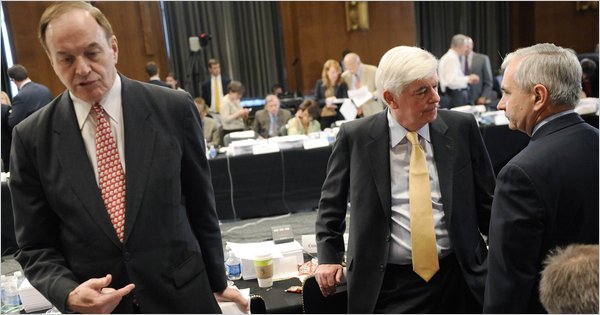
The Senators Richard Shelby, left, Christopher Dodd, center, and Jack Reed during a recess from a marathon 20-hour conference committee on the financial regulation bill.

WASHINGTON

   Nearly two years after the American financial system teetered on the verge of collapse, Congressional negotiators reached agreement early Friday morning to reconcile competing versions of the biggest overhaul of financial regulations since the Great Depression.

A 20-hour marathon by members of a House-Senate conference committee to complete work on toughened financial regulations culminated at 5:39 a.m. Friday in agreements on the two most contentious parts of the financial regulatory overhaul and a host of other provisions. Along party lines, the House conferees voted 20 to 11 to approve the bill; the Senate conferees voted 7 to 5 to approve.

Members of the conference committee approved proposals to restrict trading by banks for their own benefit and requiring banks and their parent companies to segregate much of their derivatives activities into a separately capitalized subsidiary.

The agreements were reached after hours of negotiations, most of it behind closed doors and outside the public forum of the conference committee discussions. The approvals cleared the way for both houses of Congress to vote on the full financial regulatory bill next week.

The bill has been the subject of furious and expensive lobbying efforts by businesses and financial trade groups in recent months. While those efforts produced some specific exceptions to new regulations, by and large the bill’s financial regulations not only remained strong but in some cases gained strength as public outrage grew at the excesses that fueled the financial meltdown of 2008.

Representative Barney Frank of Massachusetts, who shepherded the bill through the House, said the bill benefited from the increased attention that turned to the subject of financial regulation after Congress completed the health care bill.

“Last year when we were debating it in the house, health care was getting all of the attention and it was not as good a bill as I would have liked to bring out because we were not getting public attention,” Mr. Frank said. “What happened was with the passage of health care, the American public started to focus on this.”

Senator Christopher J. Dodd of Connecticut, the Democratic chairman of the Senate Banking Committee, said legislators were still uncertain how the bill will work until it is in place. “But we believe we’ve done something that has been needed for a long time,” he said.

Treasury Secretary Timothy F. Geithner also praised the conference committee for its work. “All Americans have a stake in this bill,” he said. “It will offer families the protections they deserve, help safeguard their financial security and give the businesses of America access to the credit they need to expand and innovate.”

Legislators had aimed to finish their reconciliation work before President Obama travels to a G-20 meeting this weekend in Ontario, and to approve and deliver a final bill for the president’s signature by Independence Day.

At two minutes before midnight Thursday, some 14 1/2 hours after they began work Thursday morning, members of the House-Senate conference committee approved a final revision of the measure known popularly as the Volcker Rule.

The rule, named for Paul Volcker, the former Federal Reserve chairman who proposed the measure this year, restricts the ability of banks whose deposits are federally insured from trading for their own benefit. That measure had been fiercely opposed by banks and large Wall Street firms, who viewed it as a major incursion on some of their most profitable activities.

“One goal of these limits is to reduce participation in high-risk activity that can cause significant losses at institutions which are central to the financial system,” Mr. Dodd said. “A second goal is to end the use of low-cost funds — to which insured depositories have access — to subsidize high-risk activity.”

Banks managed to wrangle limited exceptions to the rule that would allow them to continue some investing and trading activity. The agreement limits banks’ investments in hedge funds or private equity funds to no more than 3 percent of a fund’s capital; those investments could also total no more than 3 percent of a bank’s tangible equity.

Many Wall Street firms, including Goldman Sachs, Morgan Stanley and others, have long engaged in significant amounts of trading for their own accounts, a practice that commercial banks and their parent companies were traditionally less inclined to adopt.

The Wall Street institutions might not have been subject to the new rules except for their decisions during the 2008 financial crisis to convert themselves into bank holding companies in order to gain access to the emergency lending authority of the Federal Reserve.

Most of the first 12 hours of Thursday’s meeting by the committee was spent in recess, as senators and House members huddled with staff members, consulted with Treasury Department officials, were buttonholed by lobbyists, traveled to their respective chambers for votes and waited for proposals and counter-offers to be printed and collated.

After seven hours of additional debate, the conferees approved revisions to the derivatives legislation that would require banks and their parent companies to segregate much of the derivatives trading businesses.

The final restrictions were not as tight, however, as originally approved by Senator Blanche Lincoln, the Arkansas Democrat who is chairwoman of the Senate Agriculture Committee, which oversees the Commodity Futures Trading Commission, the chief regulator of derivatives.

Mrs. Lincoln’s proposal that banks be banned from all derivatives activity drew opposition from both sides of the aisle almost since it was introduced this spring. But the provision remained in the Senate bill in part because Mrs. Lincoln was facing a tough primary battle in her home state and portrayed herself as a tough critic of Wall Street.

Mrs. Lincoln won that primary in a runoff, a development that again made legislators somewhat reluctant to oppose her derivatives proposals with the general election looming. Only in recent days did a group of centrist House Democrats threaten to withhold their approval of the entire package unless Mrs. Lincoln loosened her derivatives restrictions.

The group, known as the New Democrat Coalition, includes several House members from New York State, who voiced opposition to provisions that they felt would threaten business and jobs on Wall Street.

Outside of the conference committee chambers, discussions took place through much of the afternoon between Mrs. Lincoln’s staff and groups that have been seeking to produce a compromise derivatives proposal, including other Senate negotiators, Treasury and White House officials, and a group of House members led by Representative Melissa Bean, an Illinois Democrat.

Representatives from the New Democrats met on Thursday with White House officials, according to a House aide, and later presented a proposal to Mrs. Lincoln. At 9:10 p.m., Mrs. Lincoln returned to the conference committee room after a long absence and huddled with Mr. Dodd, who had voiced fears that the derivatives measure would make it more difficult to retain the 60 votes needed to pass the revised bill through the Senate.

The conference committee also reached substantial agreement on a provision that would exempt auto dealers from the authority of the Consumer Financial Protection Bureau, a major victory for one of the most active lobbying groups on the financial bill in recent weeks and an equally disappointing defeat for the Obama administration.

The White House and the Pentagon had both pushed aggressively for restrictions on companies that offered and promoted auto loans, which military officials said were the cause of numerous complaints of consumer fraud by members of the military and their families.

Republican members of the committee in recent days repeatedly offered amendments that were rejected on party line votes and raised issues that Democrats were little interested in entertaining. Republicans repeatedly faulted the majority for not including an overhaul of the mortgage firms Fannie Mae and Freddy Mac in the financial bill; they also raised objections to the bill’s provisions for unwinding failing financial firms, saying that the bill would not rule out future taxpayer-financed bailouts.

Earlier Thursday, Mr. Frank pushed numerous minor provisions of the 1,500-page financial bill toward agreement.

Among the provisions approved by representatives of both the House and the Senate was one that would give the Securities and Exchange Commission the authority to require stockbrokers to protect their clients’ interest when recommending investments, potentially subjecting brokers to the same fiduciary duty as financial advisers.

Members of the committee from both houses of Congress adopted a proposal that would require the S.E.C. to complete a study within six months of the financial bill’s enactment to evaluate the effectiveness of current rules governing those who give financial advice to or sell securities to consumers.

Under current law, financial advisers are required to act in the best interests of their clients, while brokers are held to a looser standard, under which they are required only to consider whether an investment is “suitable” given the time horizon, goals and appetite for risk of a client.

The compromise calls for the S.E.C. to take the results of the study into account when making any rule, but it also gives the commission the authority to impose a fiduciary standard on stock and insurance brokers. The commission may also require brokers to disclose that they are offering only proprietary products and to reveal how much they are being paid for particular products.

By the end of its work on Friday morning, the House and Senate negotiators had substantially completed work on all of the bill’s 15 titles. Minor work remained on technical amendments that would not substantially change the bill’s provisions.

The Congressional Budget Office estimated that the financial regulatory bill would cost roughly $20 billion over 10 years. The conference committee agreed to pay for the bill by imposing an assessment on large financial institutions; the assessments would be made according to a “risk matrix” that charges higher amounts to riskier institutions.

Mr. Frank said that the assessments — which Republicans called a tax — were an acceptable solution for “the collective errors of many in the financial institutions that caused this set of problems.”

Read more...

LEGAL DECLAIMER

The content available under the terms of GNU Free Documentation License and Creative Commons Attribution-Noncommercial-No Derivative Works 2.5 India License. We're not responsible for any type of damages occured, while using of iEncyclopedia's content. For commercial content licensing, do follow the instructions in the Content Licensing Section to gain the commercial content license.

* * All text is available under the terms of the GNU Free Documentation License.

© iEncyclopedia Society, 2013.